Who is Beacon?
Beacon is a team of world-class software engineers, product leaders, and service professionals. Our experience comes from companies like Meta, Intuit, Logitech, and Aurora (self-driving cars), as well as service companies within plumbing, utilities, HVAC, fire, and life safety. We believe your property should be self-aware and autonomous, that's why we've built Autonomous Building Intelligence™ (ABI).
What does Beacon do?
Simply put, we capture all your building's data to make saving money insanely easy.
That starts with benchmarking, regulatory requirements, compliance, reporting, and real-time monitoring for any property. That will evolve into your building autonomously seeking it's own compliance, alerting you of issues like leaks, and providing you with opportunities and recommendations to maximize saving money across all of your properties.
If you're a building owner or property manager, whatever makes your life most difficult, let Beacon do it for you.
What is benchmarking?
Benchmarking is the regulatory requirement to collect and measure the current energy usage of a building and comparing it against historical energy usage, or comparing your building to buildings of a similar size and occupancy.
To avoid state fines and be compliant, benchmarking must be done through the ENERGY STAR® Portfolio Manager.
The ENERGY STAR® resource management tool enables you to benchmark the energy use of any type of building.
What's happening in California?
The Building Energy Benchmarking Program requires owners of large commercial and multifamily buildings to report energy use to the California Energy Commission by June 1 annually.
What is CA AB 802?
If your building is over 50,000 square feet, you must comply with the AB 802 ordinance. However, there are some AB 802 Exemptions and Exceptions. Beacon simplifies the energy benchmarking process, ensuring your compliance with AB 802 is hassle-free.
Requirements
If your building is over 50,000 square feet, you must comply with the AB 802 ordinance.
Exemptions
A building owner is exempt from the requirements for a building meeting any of these conditions:
- No certificate of occupancy during the 12-month reporting period
- Scheduled to be demolished within one year of the reporting data
- The building was benchmarked pursuant to a local program listed on the Energy Commission website
Exceptions
The report is not required if more than half of the building's gross floor area is used for:
- Industrial (manufacturing, fabrication, processing) purposes
- Scientific experiments requiring a controlled environment.
Does your California city have unique benchmarking requirements?
Some cities in California have different requirements for benchmarking properties. Below are the specific requirements mandated by California.
| Area | Deadline | Requirements | Fines & Penalties |
|---|---|---|---|
| California | June 1st annual deadline | 50,000+ sq ft for commercial and multifamily buildings All state buildings, owned or leased, must be benchmarked, regardless of size. | The civil penalty shall not be less than five hundred dollars ($500) nor more than two thousand dollars ($2,000) for each category of data the person did not provide and for each day the violation has existed and continues to exist. |
| Berkeley | June 1st annual deadline | 15,000+ sq ft for municipal, commercial, residential, and multifamily buildings Energy Assessment due every 5 years or at time of sale for buildings under 25,000 sq ft | The instances of noncompliance will result in a fine of $100 for each violation, and an additional fine of up to $25 for each day that the violation continues, up to a maximum of $1,000 per violation. |
| Brisbane | May 15th annual deadline | 2,000+ sq ft for public buildings and 100,000+ sq ft for commercial, multifamily, and industrial buildings Building Performance Standard or Energy Audit Requirement due every 5 years | $100 after 30 day notice. $200 after another 30 days. $500 after another 30 days and every 30 days after. |
| Chula Vista | May 20th annual deadline | All public city buildings and 20,000+ sq ft commercial, industrial, and multifamily properties Building Performance Standard or Energy Audit and Retro-Commissioning Study every 5 years | 20,000-49,999 GFA - up to $750 per incident; 50,000-99,999 GFA - up to $1,500 per incident; 100,000+ GFA - up to $2,250 per incident |
| Los Angeles | June 1st annual deadline | 7,500+ sq ft for public city buildings and 20,000+ sq. ft. for all other buildings Energy Assessment and/or Retro-Commissioning Study due every 5 years | Buildings that do not comply with the Existing Building Energy & Water Efficiency Program by the deadline will be publicly disclosed and may be charged a compounding fine. |
| San Diego | June 1st annual deadline | Public or commercial properties 50,000+ sq ft and mixed-use properties 50,000+ sq ft with 17 or more residential accounts
| The fines for non-compliance are up to $1,000. |
| San Francisco | May 1st annual deadline | 10,000+ sq ft for commercial and industrial buildings and 50,000+ sq ft for multifamily buildings Energy Audit every 5 years for commercial and industrial buildings. Large commercial buildings renewable electricity ordinance | Owners of buildings larger than 50,000 square feet are subject to $100/day fines for each day of noncompliance (up to a maximum of 25 days). Owners of buildings smaller than 50,000 square feet are subject to a $50/day fine (up to a maximum of 25 days). |
| San Jose | May 1st annual deadline | 20,000+ sq ft Building Performance requirement, Energy Audit, or Retro-Commissioning Study every 5 years | Buildings 50,000 square feet and above may be fined $50 for each day of noncompliance, up to $5,000 per calendar year. |
Are there fines and penalties?
Violations can carry a penalty of up to $2,000 for each category of missing data, which can apply for each day the violation has existed and continues to exist. CEC staff will provide advance notice if a case is opened regarding your building.
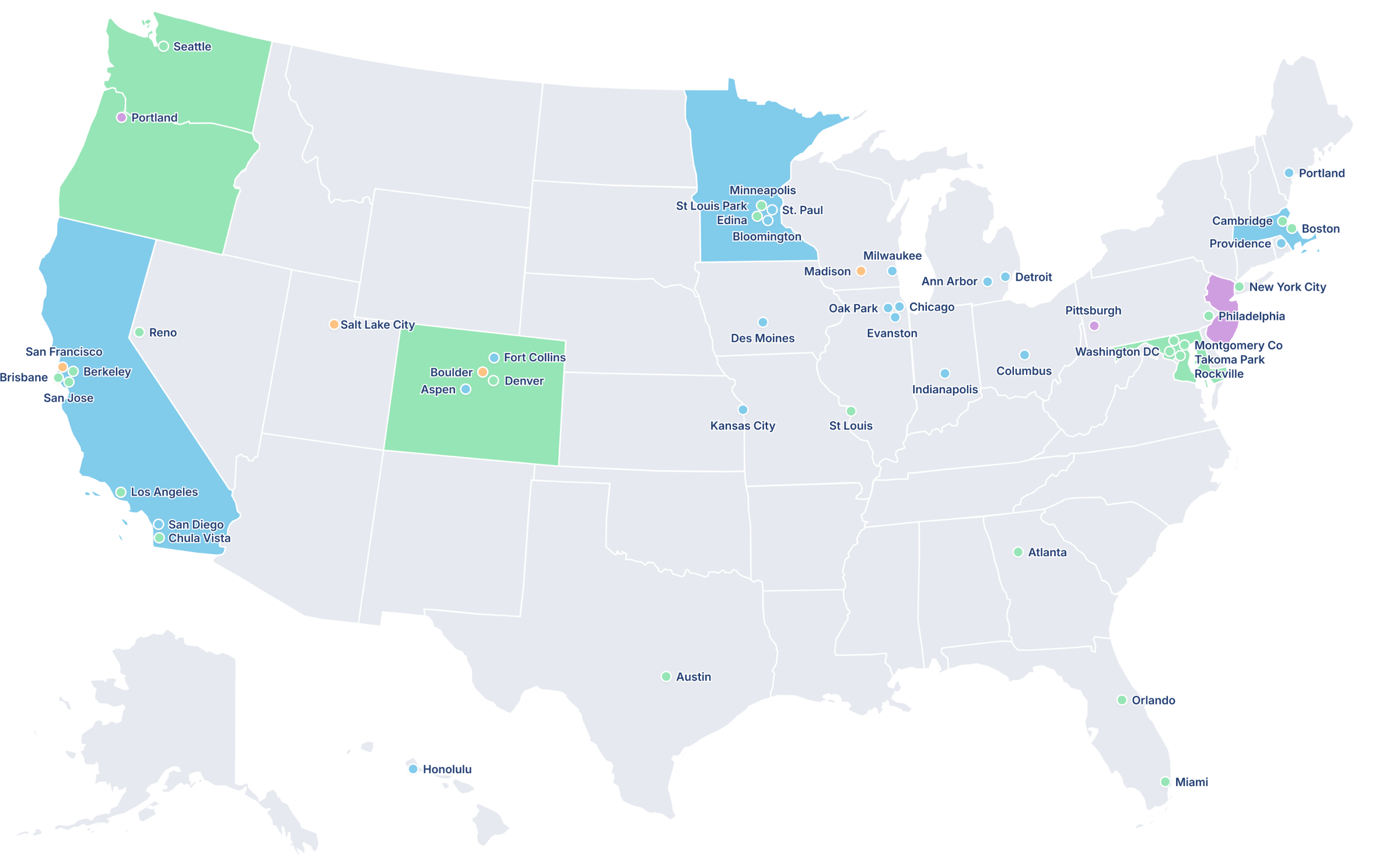
What about the rest of the US?
Some cities, counties, and states have different requirements for benchmarking properties.
Where are there specific city, county, and state benchmarking policies?
Some cities, counties, and states have different requirements for benchmarking properties. Below is a map of the requirements across the US.